by Mike Maxwell September 19, 2026 6 min read

Buying your first vintage Arsenal shirt is exciting, and a little nerve-wracking. There are decades of designs to choose from, prices that run from the cost of a takeaway to a serious spend, and plenty of fakes in circulation. This guide is a practical checklist for the buying process itself: deciding what you want, understanding the different types of shirt, setting a budget, judging condition and size, and knowing what to ask before you commit.
If you want the history and the most famous designs first, start with our complete guide to Arsenal shirts.
The right shirt depends on why you want it.
Being clear on this early stops you paying collector prices for a shirt you only want to wear on a match day, or the reverse.
Listings use a lot of loose terms, and the difference can be worth a lot of money.
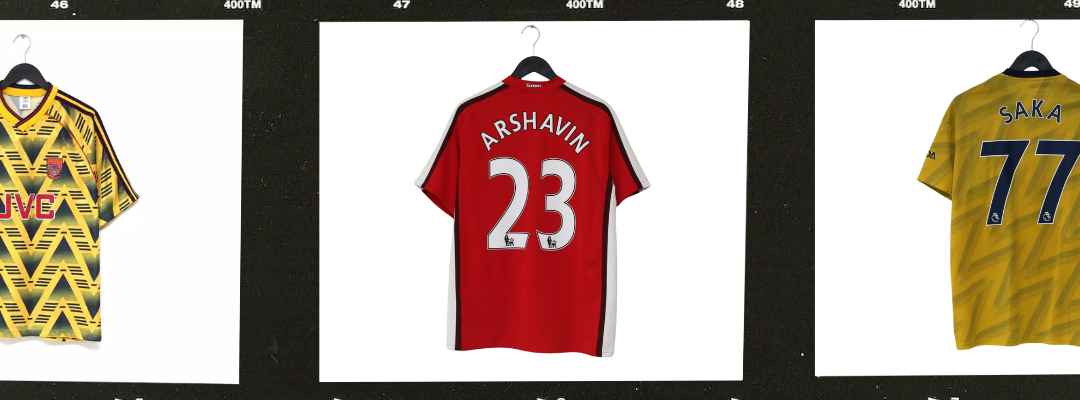
The reissue question matters. In the last 12 months a 1991/93 “Bruised Banana” adidas Originals reissue sold on Football Shirt Collective at £150. Our complete guide puts original Bruised Banana shirts at £250 or more. Both are legitimate products, but you should know which one you’re paying for.
Each manufacturer era has its own look and price profile.
We cover the most famous designs in the complete guide, and you can read our rankings of the best Arsenal adidas shirts of the 90s and the very best Arsenal Nike shirts.
Prices depend on the season, the name on the back, the size and the condition. Here is what Arsenal shirts sold for on Football Shirt Collective over the last 12 months (gross sales per item, so treat them as ranges):
| Type of shirt | Typical price range |
|---|---|
| Henry, 1999-2001 Nike (Sega home and away) | roughly £160 to £204 |
| Henry, 2004-08 Nike | roughly £102 to £154 |
| Wright, 1992-95 adidas and Nike | roughly £167 to £208 |
| Arshavin, 2008-10 Nike | roughly £80 to £113 |
| Bendtner, Eduardo and Reyes, Nike era | roughly £75 to £102 |
| Saka, adidas 2019-22 | roughly £60 to £65 |
| Bruised Banana reissue (adidas Originals) | £150 |
The pattern is simple: a famous name in a famous season means a higher price. On a tighter budget, choose a less famous name from the same era, a plain shirt in a design you love, or a long-sleeve version, which several of our sales came from. Socks, tees and scarves are an inexpensive way to own a piece of a classic kit.
Counterfeits are still out there, so check before you pay. The quick checks are the crest, the manufacturer logo, the swing tag and inside-neck label, the quality of the name and number printing, and, on modern shirts, the product code. Search the code: a genuine one returns Arsenal products, while a fake often returns something unrelated. Our full guide to spotting a fake Arsenal shirt explains exactly what to look for, and we have a separate guide to spotting a fake 2005-06 Arsenal home shirt.
If a price looks too good for a Henry or Wright shirt, it usually is.
Vintage shirts are decades old, so some wear is normal. What matters is that it’s described honestly. Look for:
Ask for clear photos of the front, back, badge, sponsor, label and any flaws. If a seller only shows one distant photo, that tells you something.
Sizes have changed a lot over the years. Older shirts are generally cut larger, and a 1990s “L” can fit like a modern XL or XXL, while some 1980s shirts run small. Nike shirts from the mid-1990s onward became gradually slimmer. Don’t trust the tag alone.
There is more detail in the sizing section of our complete guide.
A good seller will answer these quickly and clearly.
Wash cold, inside out, on a gentle cycle, and never tumble dry. Keep irons and heat away from badges, sponsors and printing. Store it folded or on a wide hanger, away from direct sunlight.
How much should I pay for a vintage Arsenal shirt? It depends on the season, the name and the condition. In our recent sales, Saka-era adidas shirts sold at around £60 to £65, Arshavin-era Nike shirts at roughly £80 to £113, and 1990s Wright and Henry shirts at roughly £160 to £208.
What’s the difference between an original and a reissue? An original was made and sold in the season. A reissue is a newer shirt recreating an old design. Reissues usually cost less, so check which one you are buying.
Is a replica the same as a fake? No. A replica is an official fan version. A fake is an unofficial counterfeit.
How do I know a shirt is genuine? Check the crest, manufacturer logo, labels and tags, printing quality and, on modern shirts, the product code. Our guide to spotting a fake Arsenal shirt explains how.
Browse our range of vintage Arsenal football shirts, or read our complete guide to Arsenal shirts for the history behind the classics.
Sign up to get the latest on sales, new releases and more …