

Over the past few weeks we’ve honed our fake spotting skills, looking at kits from the likes of Nike and adidas, sorting fact from fiction along the way.
Of course, despite their massive footprint Nike and adidas only make up a couple of (admittedly large) slivers of the football shirt pie. Alongside the big names, a host of other manufacturers populate the market with many designs that rival the American and German giants in terms of aesthetics.
Putting design aside for a minute though, are fakes of these ‘other’ vintage football shirts easier to spot, harder to spot, or largely the same?
We’ll continue our series with a closer look at Kappa, and as you'll soon see the brand have actually made our jobs easier in a number of ways...
What you need to know about spotting a fake Kappa football shirt
| Nike | adidas | Puma | Umbro | General |
Let’s start with the best news.
If you own a Kappa shirt, the brand themselves have set up a site which you can use to check the authenticity of your shirt!
Though searching for product codes or serial numbers is viable for other brands, no one else makes the process as straightforward as Kappa. A link to the site (BasicLabels.net) is included on a small internal label, and you can also scan a QR code instead of manually entering the product code.

Here are a couple of examples of labels, with the corresponding results pages on BasicLabels. It’s that simple. A fake Kappa football shirt will either be missing the serial number entirely, or will return no results or a shirt that doesn't match what the label is attached to.


Be aware older Kappa shirts will not be searchable, but anything from recent seasons will be covered.
Shoutout to @elclasicokits for pointing out that the tiny dots on the main inside label of vintage Kappa kits are a key indicator for whether a shirt is fake or not.
As 90s Kappa shirts are some of the most faked out there, this piece of advice is like gold dust. You want to see 6 dots diagonally in two lines, rather than a more scattered correlation.
Some genuine shirts may have a different number of dots, but the key is the uniformity of the dots on the label. See a couple of examples below of genuine Kappa shirts.
Biggest giveaway, for me, for Kappa shirts, are these dots.
— El Clàsico Kits (@elclasicokits) December 22, 2020
Should be 6 dots diagonally within the triangle, like in the second picture! pic.twitter.com/wAY62Lg7Fy
Double check all other internal labels to make sure what you’re looking at in person or online is legitimate. The Kappa logo (more on that shortly) should be exactly the same as what you can find from pictures online.
As you can see in the helpful comparison picture below, the legitimate shirt on the left has considerably more labels than the fake shirt on the right. The Kappa wordmark on the fake shirt is also noticeably different on closer inspection.

Other Kappa shirts will have internal labels with the Omini logo (two people sitting back to back). Don't let that put you off, it's simply the style used particularly on older shirts.
Barcelona's Kappa shirts are a good example of how much labels vary by era. The 1992–95 home shirts have no Kappa logo on the front at all, just a club "Barça F.C.B." neck label and a "Sports Kappa S.A." manufacturer label inside. See our guide on how to spot a fake Barcelona shirt for photos of genuine Kappa-era Barça labels.
The Kappa ‘Omini’ logo is famous for its distinctive look, and indeed on shirts both old and new a legit shirt will stand out for its accuracy on things like the noses on the silhouette (particularly visible on modern player issue shirts).

By contrast, the fake shirt below simply isn’t the Kappa logo. There is what looks more like a trailing stitch than an arm running from the heads to the arms, the body shapes in general are wrong, and the Kappa wordmark is a mess.

Some fake logos are a lot better than others, and in a comparison of the same shirts we looked at in the previous section the fake logo here is virtually identical. In this situation, the fake Kappa football shirt colour and material is the biggest giveaway, so don’t solely rely on the Kappa logo when checking.
For the Kappa wordmark, you can refer to the pictures in the previous section regarding internal labels. Like the adidas logo, you want to make sure those letters are equally spaced and not bulging unnecessarily.
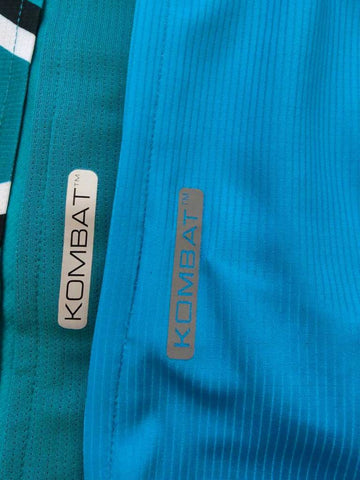
A word on the jock tag of modern player issue Kappa shirts. This is an area fakers often struggle to replicate for whatever reason. You’re looking for a small, simple “KOMBAT” patch which is solid, like the example below. This can appear in a range of colours.

Fakes will often have the “KOMBAT” cut out of the tag (right on the comparison below), so alarm bells should sound if this small but visible detail is iffy in any way.
A big thank you to the members of the shirt community who provided the pictures seen throughout this piece. It goes without saying that the community is an incredibly helpful place, and ultimately the best sort of resource you could ever find when trying to identify a fake Kappa football shirt. I learnt a bunch myself just putting this together, and it’s thanks to everyone else!
Kappa will remain eternally popular with collectors for good reason, and now you’ll be armed with the tools you need to shop for vintage Kappa goodness or modern Kappa classics with confidence.
Next up in our brand series, read our guide on how to spot a fake Puma football shirt.
| All | Arsenal | Manchester United | Liverpool |
For modern shirts, check the serial number or QR code on the small internal label using Kappa's own authenticity site. For vintage shirts, check the dots on the main inside label and the internal labels in general. Then check the Omini logo, the evenness of the Kappa wordmark and, on player-issue shirts, the "KOMBAT" jock tag.
Kappa runs an authenticity site, BasicLabels.net. Enter the serial number from the small internal label or scan its QR code, and it should bring up the exact shirt. If there's no number, no result, or a different shirt comes up, it's likely fake. Older Kappa shirts aren't covered.
On vintage Kappa shirts, the main inside label has a small group of dots. On genuine shirts they're neat and uniform, usually 6 dots in two diagonal lines. The exact number can vary, but scattered or uneven dots are a strong sign of a fake.
On modern player-issue Kappa shirts it's a small, solid "KOMBAT" patch, which can come in a range of colours. Fakes often have the lettering cut out of the tag instead.
No. Many fakes get the Omini figures visibly wrong, but some copy the logo almost perfectly. Always check the labels, the colour and material, and, where possible, the serial number too.
Yes. Every shirt is hand-checked before listing and photographed in detail (10+ photos per shirt), and we're rated Excellent on Trustpilot. There are no fakes and no exceptions. Browse authentic Kappa football shirts here.
If you enjoyed this blog on fake Kappa shirts then why not sign-up to our weekly Collectors Club Newsletter to receive more great tips each week? You can sign-up here.